Monday, April 11, 2011

Pompeii Worms and Proteobacteria: Voted Hottest Couple

Introduction:
In high school there's always one couple that seems so perfectly matched, like the typical star quarterback and head cheerleader relationship. He carries her heavy books to class and she brings him ice cold water to practice. These types of people win prom king and queen in every cliche movie and will inevitably live happily ever after. The natural world also has its own superlative categories. Alvinella pompejana, commonly referred to as the Pompeii worm, is an extremophile polychaete that resides in the East Pacific Rise hydrothermal vents deep in the Pacific Ocean [1]. In this environment, temperatures can be as hot as 176º F and the five inch worm is still able to survive [2]. It is the most heat tolerant animal and can have a broad temperature gradient along its body. Tentacle-like gills adorn the A. pompejana's head as if to crown itself with the title "hottest creature on earth." Despite the Pompeii worm's adaptations to extreme environments, thermal vents are unstable habitats so the worms are probably inclined towards methods of dispersal with large numbers of offspring. However, like most deep sea vent creatures, the full life cycle of the Pompeii worm remains unknown [3].

[4]

Pompeii worms insert their tails into the side of the vents, leaving their head exposed to the milder waters of 72°F [5]. How is the worm able to tolerate such a range of temperatures? The secret lies in a fuzzy hairs along the Pompeii worm's body. The "fleece" is actually bacteria.

[6]
Colonies of filamentous Proteobacteria form a protective coating over the worm's mucus glands [7]. It's not quite a letterman's jacket that the previously mentioned football star would give his cheerleader girlfriend. In fact, it's a more profound mutualistic relationship.


Description of Relationship:
The bacteria and A. pompejana are protected from the extreme heat by enzymes in the epibacteria. Some research indicates that the bacteria serves as thermal insulation [1]. In return, the Pompeii worm secretes a mucus that the bacteria lives and feeds upon [3]. This relationship has evolved to a level of morphological functionality. The bacteria and the mucosal secretions are part of the worm and contribute to protecting it from the vent temperatures [3]. Metabolic processes for the worm may also depend on the bacteria because of the extreme conditions in their habitat. The bacteria can transform inorganic substances into usable sources of energy, and thus helping the worm survive nutritionally as well.


Cost/Benefit Analysis:
Both organisms benefit from the other, the worm gains protection and sources of energy, while the bacteria gains a place to live and sustenance (Pompeii worm mucus). The worm encourages bacteria attachment by secreting the mucus, so the costs of housing the worm are outweighed by benefits. Diversity of life in the hydrothermal vents is very small, due to the lack of organismal adaptations to such conditions. Extremophile bacteria's reliance on the Pompeii worm is purely beneficial.


References:
1. http://en.wikipedia.org/wiki/Pompeii_worm
2. http://aem.asm.org/cgi/reprint/63/3/1124
3-http://www.jmst.org.tw/marine/15-2_1/37-53.pdf
4. http://ursispaltenstein.ch/blog/images/uploads_img/deep_sea.jpg
5. http://wapedia.mobi/thumb/3ad1500/en/fixed/470/300/Grand_prismatic_spring.jpg?format=jpg
6. http://alvinella.igbmc.fr/Alvinella/images/alvinelle.jp
7. http://www.ceoe.udel.edu/extreme2003/creatures/pompeiiworm/index.html/biologylibrary.blogspot.com/2010/06/hot-hydrothermal-vents.html
8. http://microbewiki.kenyon.edu/index.php/Deep_sea_vent
9. http://aem.asm.org/cgi/reprint/63/3/1124
10. http://web.uvic.ca/sciweb/images/hydrothermal-vent.jpg
11. http://www.bbc.co.uk/nature/images/ic/credit/640x395/p/po/pompeii_worm/pompeii_worm_1.jpg

Thursday, April 7, 2011

You Look This Way, I'll Listen That Way


Introduction
Oxpeckers are not the only birds that zebras have been known to pair with – they also are often found in the company of ostriches. Both of these species are justifiably concerned with approaching danger [1]. Equus burchellii, more commonly known as the plain zebra, is geographically widespread. They are social animals that spend time in herds. Zebras must be constantly wary of lions and hyenas. They travel in herds so more eyes are on alert for danger. If an animal is attacked, its family will come to its defense, circling the wounded zebra and attempting to drive off predators [2]. Struthio camelus, more commonly known as the common ostrich, is found roaming around in Africa. The ostrich is the world's largest flightless bird that also travels in small herds that typically contain less than a dozen birds [3]. Ostriches have to be aware for cheetahs, lions, African wild dogs, leopards and spotted hyena. The male ostrich is a threatening opponent and will strike out at a predator, however in most cases ostriches are able to out run their pursuer [4]. Ostriches and zebras are both prepared to warn one another at a moment’s notice so they can each flee as needed.


Relationship
Mutualism is a relationship between two species of organisms in which both benefit from the association. Ostriches share a mutualistic relationship with zebras. Ostriches tag along with a herd of zebras because they have a poor sense of hearing and smell, so they take advantage of the zebras strong hearing and smell senses [5]. Ostriches have a sharp sense of sight, which zebras lack. Thus, these two species rely on each other to inform one another of any nearby dangers; together they are more successful at fleeing from predators.


Cost/Benefit Analysis:
For zebras, there seems to be no cost. Ostriches are very beneficial by providing a better of sight that zebra’s lack. Ostriches also seem to have no cost. Zebras are beneficial to the ostrich by providing a sharp sense of hearing and smell which ostriches lack. Therefore, as mentioned above, these species employ a mutualistic relationship. The ostrich and zebra both benefit by utilizing each other’s senses and protecting one another from predators.

Reference:

Wednesday, April 6, 2011

Who Says a Hoarder Doesn't Like to to Share?

Bushy-tailed Wood Rat - Neotoma cinerea (packrat)[2]

Introduction: Pseudoscorpions is a flattened, oval, brown, black or brownish-green colored arthropod with a short fang-like appendage in front of its mouth (chelicerae). The appendage has a fixed and movable finger that allows the “scorpion” to grasp items. Also, like most arachnids it has a pedipalp, which is a pincer-like claw capable of clasping and crushing prey and secreting poison from a gland (1). Unlike the common scorpion it does not possess a long tail and is unable to sting other organisms. It is a small organism that usually reaches 5 millimeters, even though one species is capable of reaching 12 millimeters (3). Pseudoscorpions have spinnerets that allow them to produce silk for the construction of nests. On average females produce three to four clutches of eggs at a given time. The female carries her eggs until the young hatch. Although the lifespan of the Pseudoscorpions is unknown, it is believed that the adult can live anywhere from six months to two years.

[7]

Description: Pseudoscorpions feed on small insects and other arthropods, such as ants and caterpillars. They are commonly found in leaf litter, rotten logs, bark, bogs, swamps, homes, and under rocks (1). Packrats, also known as the trade rat or wood rat, are common in the deserts and highlands of western U.S. and northern Mexico, and eastern U.S. and Western Canada. They are characterized by their small stature and bushy tails, piercing call, and surprisingly an attraction to shiny things. As protection from predators, they build complex nests out of twigs and incorporate cactus spines into its design (4). To bind the objects together they urinate on the nest- the sugars and other substances crystallize to fortify the materials (4). Packrats are known for their constant search for twigs, rocks, animal dung, leaves, and sticks to add to their ever-expanding nest. Hence, the term “pack-rat” used to describe a person who accumulates materials.

How do these two organisms relate? Pseudoscorpions have established mutual relationships with birds and rodents (in this case packrats) by consuming other arthropods that invade the nest. Some species are phroretic- live on beetles and large insects, where they feed on mites in return for increased motility.

[5] Cost/ Benefit Analysis: In a phoretic relationship, the transporter gains nothing, while the other organism gains motility. According to The Art of Being a Parasite the Pseudoscorpions can become a burden on the transporter if too many passengers were to climb on board the beetle (6). However, it was observed that the Pseudoscorpion lives in the nest of the rodent. The Pseudoscorpions eats packrat ectoparasites (i.e. larval and adult fleas) and finds a place of shelter from predators, namely for reproduction. The packrat in turn receives relief from fleas, which are a nuisance because they can cause changes in the behavior of the rat, weight loss, and fur loss. All of which reduce the health of the rat, making it more vulnerable to pathogens. There is no cost incurred from this association.

Works Cited

1. http://entowww.tamu.edu/fieldguide/cimg375.html

2. http://www.americanarachnology.org/gallery_pseudoscorpiones.html

3. http://www.britannica.com/EBchecked/topic/448550/pedipalp

4. http://www.crittercontrol.com/facts/animals/packrats.html

5. http://www.localpestcontrolservices.com/pest_control_blog/arizona-pest-control/rats_pack_rats_nest/

6. The Art Of Being a Parasite

7. http://www.discoverlife.org/nh/cl/GSMNP/arachnid/key/key_order.html

I need You to Survive!

Source
  Introduction: Fig wasps belong to the family Agaonid. These insects are closely involved with fig trees, Ficus.  Each species of fig wasps works closely with a specific type of fig tree. Figs trees are originally from the Mediterranean area, but they are grown all over the world [2], and there are multiple different varieties of figs as well. A fig tree has two types of fruit, caprifigs which are male and edible figs which are female [1]. The lifecycle of this relationship starts when a female wasp covered in pollen enters the ostiole, opening of an unripe fig, of a caprifig. While crawling through, the female usually loses her antennae and wings, so she will never escape. The female eventually reaches an area known as the syconium, which has both male and female flowers. There she lays her eggs and releases the pollen that she brought from her original fig and then she dies [3]. While the figs are ripening the male eggs hatch first and find the female eggs and fertilize them. Then the male eggs start chewing a hole in the fig to make an escape route for the females. Later the female wasps hatch and cover themselves in pollen. Once they have enough pollen they fly through the hole in search of another fig tree. And thus the cycle continues [4]. If a female wasp enters a female fig she eventually dies, but her death is not in vain because the pollen that she brings fertilizes the fruit, and creates the fruit people/animals eat[1].


Source
  Description of Relationship:  The relationship between figs and fig wasps has been occurring for the last 80 million years [1].  It is apparent that these two species coevolved over the years and have become dependent on each other in order to survive [2]. This relationship is also known as a mutualistic relationship because both the fig tree and fig wasp benefit from each other. These two species exist because the other helps with the process of reproduction. The biology of the female wasps is that they have wings and are able to fly [3]. The male wasps have no wings and are unable to fly [3].


Source
  Cost/Benefits Analysis:
The cost of this relationship is very minimal to the benefit. Fig trees main cost of this relationship is being dependent on the fig wasp. If the fig trees cannot get their flowers fertilized by the wasps they are unable to reproduce which is a major problem. The fig wasps main cost is sacrificing the mother wasp to the fig tree because she is unable to escape due to the loss of her antennae and wings. The benefit between this mutualistic relationship is that both species are able to reproduce through the help of the other species. Also the fig tree gives shelter to the fig wasps, and in return the fig wasps fertilize the flowers of the fig which are found within. The cost outweighs the benefit because through sacrificing the mother wasp she is able produce many more wasps that will carry on to the next generation.


Movies to Watch


References 


Tuesday, April 5, 2011

Wolbachia: Enemy Becomes Friend


Introduction: A parasite whose "hand" seems to be in the pots of many is Wolbachia bacteria. Wolbachia is perhaps one of the most successful parasites [1]. Not only can it affect a wide array of hosts, but it does so effectively. This suggests that the parasite is highly compatible with its host. The Wolbachia is a genus, not a species. There are many different species of Wolbachia that correspond to different hosts although most of the species are closely related [2]. This post will focus on some of Wolbachia's most outstanding and noteworthy hosts. These hosts include but are not limited to Drosophila melanogaster, Asobara tabida, and Trichogramma wasps. Drosophila, more commonly known as the fruit fly, can be found near unripe or rotten fruit. The two latter hosts, both parasitic wasps, can be found in ferilte, infertile, or dead eggs of various host insect species. Wolbachia can be found all over the world. The bacteria affect a grand total of sixty percent of the arthropod population alone. Wolbachia are also capable of infecting spiders and filiarial nematodes. The fruit fly has a total lifespan of only thirty days at optimal temperatures. Trichogramma wasps live for about eight to ten days while A. tabida, can live for an average of fifteen days. Ecologically speaking, the importance of Wolbachia in regards to the hosts are simple: by understanding a highly prevalent parasite and its genetic effects upon hosts, it can hopefully be manipulated to serve ulterior purposes. Also, the prospect of horizontal transmission makes Wolbachia that much more evolutionarily fascinating in the eyes of science because it can cross a barrier that typically impedes transmission [2]. The main targets of Wolbachia research are Dengue fever and the ever-popular Malaria (both of which are vector-borne) [3]. It is hoped that by understanding the Wolbachia genome and its host interactions, the transmission of the disease can be stopped via Wolbachia infection. The main focus of Wolbachia research have been the aforementioned hosts; the idea of using Wolbachia to control or wipe out vector-borne diseases is relatively still in its infancy. However, I feel its necessary to understand the concept behind this new idea that is growing in its popularity.


Description of the Relationship:
In Drosophila, the Wolbachia relationship began as a parasitic one. As it causes in its other hosts, Wolbachia resulted in male feminization, sterility, cytoplasmic incompatibility, and parthenogenesis [1]. The specific foe turned friend is the Wolbachia pipentis. The parasite, known for it's sterilizing effects, actually reverses sterility in mutant females, increases female lifespan, and fecundity of the host [4, 5, 6, 7]. The means by which this relationship transformed is unknown. This relationship is mutualistic and highly common. The Wolbachia bacteria found in the reproductive systems of its hosts, are obligate symbionts. The entire genome of Wolbachia can sometimes be found in the genes of its hosts [8, 9]. The bacteria completely infects the ovaries of a fruit fly (left) in comparison to an uninfected ovary (right) [10].


[10]

In the both parasitic wasps, Asobara tabida and Trichogramma, both the host and its parasite have become obligate mutualists [11, 12]. In the case of A. tabida, the bacteria are necessary for the maturation of the female's oocytes [12]. For Trichogramma wasps, the bacteria are necessary for reproduction in an entirely different way. One of its parasitic effects, parthenogenesis, has become the main means of reproduction. There are extreme disparities in the male to female ratio (negligible amount of males) [11]. The Trichogramma wasp and A. tabida can be seen below [13, 14].
[13]
[14]

Cost/Benefit Analysis:

In each of the three relationships, Wolbachia is an obligate symbiont in a mutualistic relationship. The Wolbachia not only receives a habitat from its host but it also does not have to worry about the transmission of its genes. It's highly successful because it takes refuge in the reproductive systems of its hosts, is transmitted maternally (this explains the emphasis on female over male hosts) via egg cytoplasm [1, 2, 4, 5, 6, 7, 8, 9, 15]. The bacteria is a significant player in the A.tabida wasp and Drosophila; it is the opinion of the writer that the bacteria is highly evolved because A. tabida wasps parasitize the fruit fly. Not only does Wolbachia inhabit the host of the parasitic wasp, but of the parasite itself. The mutant female Drosophila owe any resulting progeny to the bacteria [6, 7]. Though the progeny will be infected, the Drosophila's fitness is increased from nil to existant. For non-mutant Drosophila, the bacteria still increase fitness [4]. As outlined in Combes' text, one of the motors of success is high fecundity [16]. With a greater number of progeny, there is a greater probability of gene transmission. Though Combes was discussing parasites, this host reaps this fitness-increasing trait from its host. In A. tabida, the bacteria, once again, rejuvenates the fitness of the female host. Upon being cured of the "infection" (Wolbachia), the female A. tabida's oocytes cannot mature (resulting in non-fertilization) [4, 11]. Her genes cannot be transmitted without the bacterial infection. In Trichogramma wasps, the bacteria is able to be transmitted intra- and interspecifically. This causes the male to female ratio to become extremely disproportional. The benefits of parthenogenesis are that it is simpler and less taxing than sexual reproduction. Less energy has to be devoted to the many facets of sexual selection (mate selection, sexually trandsmitted diseases/parasites, and less competition). However, the cost of the benefit (parthenogenesis) is a lack of genetic recombination that could increase genetic diversity. Also, sexual reproduction helps prevent harmful mutations via recombination. Both of these disadvantages (lack of sexual reproduction)are results of the sex ratio produced by parthenogenesis [11]. Wolbachia research could hopefully one day lead to the dissolution of certain parasitic infections. The aforementioned research on host relationships are the means to someday reaching that end.

References:
[1] http://news.nationalgeographic.com/news/2010/01/100126-sex-puppeteers-wasps-parasites-virgin-birth-sex-changes/

[2] http://mbe.oxfordjournals.org/content/16/12/1711.short

[3] http://www.youtube.com/watch?v=jiSOeOCe-zM

[4] http://www.brown.edu/Departments/EEB/rand/Fry.etal.04.pdf

[5] http://hydrodictyon.eeb.uconn.edu/people/fry/Evol2.pdf

[6] Combes, Claude. The Art of Being a Parasite. Chicago: The University of Chicago, 2005. 73-74.

[7] Starr, D., and T.W. Cline. 2002. A host-parasite interaction rescues Drosophila oogenesis defects. Nature. 418:76-79.

[8] http://www.ncbi.nlm.nih.gov/pmc/articles/PMC368164/?tool=pubmed

[9] http://www.rochester.edu/news/show.php?id=2963

[10] http://www.wired.com/wiredscience/2007/08/the-great-bacte/

[11] http://edepot.wur.nl/121410

[12] http://www.ncbi.nlm.nih.gov/pmc/articles/PMC1765438/

[13] http://www.lucasbrouwers.nl/blog/2010/08/bacteria-force-wasps-to-leave-sex-behind/

[14] http://www.innovations-report.de/html/berichte/biowissenschaften_chemie/bericht-42700.html

[15] http://gbe.oxfordjournals.org/content/3/209.abstract wol genome diversity?


Friday, April 1, 2011

Fruit by the Foot


Introduction

Zenaida asiatica, more commonly known as the white winged dove, is a bird native to Southwestern USA, Mexico, Central America, and the Carribbean [1]. The dove is light gray in color and gets its name from a distinct bright white wing patch. These doves are migratory birds and can fly 15 miles for water and food [1]. They can feed on a variety of fruits, seeds, and grains but are highly dependent on the fruit and nectar of Carnegiea gigantea, also known as the Saguaro cactus. The Saguaro is a large cactus native to the Sonoran Desert in Arizona [3]. White flowering plants grow on the ends of cactus branches providing nectar and food for the dove while the dove pollinates the plant, thus resulting in a mutualistic relationship [4].


Relationship

Mutualism is an ecological interaction in which two species both benefit from eachother. There are many types of mutualisms, such as dispersive mutualism. These are interactions in which one partner recives food or nutrients in exchange for moving the seeds or pollen of its mutualistic partner [6]. Since Saguaro reproduction occurs in the hottest and driest months of the year, the fruit of the cactus provides nutrients and moisture for the dove to survive during these temperatures [4]. The flowers of the large Saguaro become fruit and a new source of food for the doves. The fruit is filled with tiny seeds that, once taken up by the dove, pass through its digestive system without harm [5]. These seeds may be dropped in the feces of the dove, creating a new Saguaro plant several feet or miles away from the parent plant.

Cost and Benefit Analysis

For the white winged dove, there seems to be no cost. The cactus is very beneficial and provides the dove with much needed food and shelter during hot summer months. The dove builds a nest inside the cactus for a moist place to live in the otherwise dry desert. It also feeds on the nectar of the flowering plant obtaining food and nutrients [4]. The Saguaro cactus also seems to have no cost. The dove is beneficial to the Saguaro because it carries the cactus seeds within the nectar in its body until its feces are dropped far away from the parent cactus, thus pollinating the plant.


[1] http://en.wikipedia.org/wiki/White-winged_Dove
[2] http://www.discoverseaz.com/Wildlife/White-wingedDove.html
[3] http://www.discoverseaz.com/Wildlife/Saguaro.html
[4] http://www.desertmuseum.org/pollination/doves.php
[5] http://www.nps.gov/sagu/naturescience/white-winged-dove.htm
[6] http://www.buzzle.com/articles/examples-of-mutualism.html

Three cheers for pom pom crabs

INTRODUCTION:
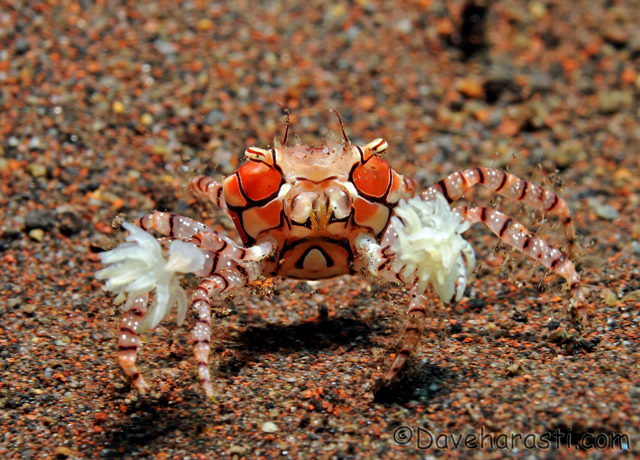
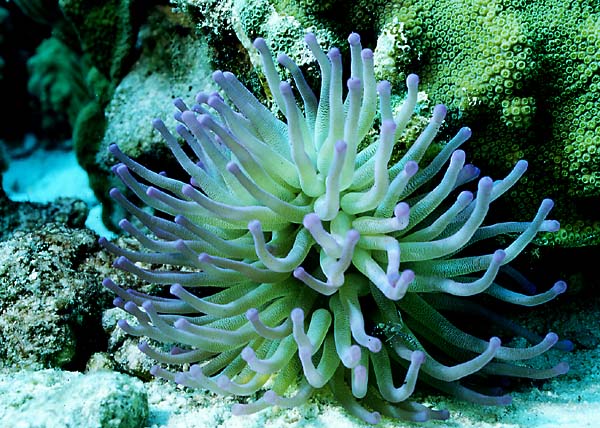
Lybia tesselata, commonly known as boxer or pom-pom crab, is a tiny, bright colored crab with striped legs and bold markings on its carapace [1]. They are best known for their behavior of using their pincers to hold sea anemones, which look like pom poms. These species are usually found in coral reefs anywhere in warm waters of the Indo-Pacific range and need rocky caves and crevices for hiding [2]. New species only emerge at night or in dim light when they feel secure. Boxer crabs are omnivores, they feed on detritus and small food particles that they pick off the substrate or that adhere to its anemone partner [1]. Sea anemones are marine organisms that belong to class Anthozoa. They are named after a wild terrestrial flower, anemone. A sea anemone is a polyp attached at the bottom of the surface and their body is topped by a ring of tentacles which are often colored. Most species thrust themselves into sand, live in furrows or attach themselves to other free-swimming organisms [3].

DESCRIPTION:
Boxer crabs and sea anemones have a mutualistic relationship in which the boxer crab carries a pair of anemones in its claws. These claws are small and delicate enough to only hold the anemones[5]. Both the organisms benefit from the relationship, providing each other with protection from predators and food. When approached by a predator, boxer crab waves the anemones in its claws at them as if it is boxing. The tiny anemones have strong stinging abilities and are so powerful that most predators back away [4]. The crab gets protection while the sea anemone obtains food particles that are dropped by the crab. Boxer crabs do not even put the anemones down to eat and typically sweep the anemones across the surface collecting food particles and debris in the anemones. The species later use their mouth to collect the food out of the anemone's tentacles. The remaining food particles that are not fetched by the crab are for the anemones to eat. During molting, the crabs place the anemones in a safe place, shed their exoskeleton and immediately pick the anemones while hiding in a safe place until a new protective exoskeleton grows [5].

COST/BENEFIT ANALYSIS:
Since the crab-anemone have a mutualistic relationship both of the organisms benefit from each other. As stated above, the sea anemone's tentacles provide the crab with protection from its predators. In return, the crab supplies the anemone with a constant food supply and helps the sea anemone catch more food by moving it from place to place. Moreover, the anemones are also used by the crabs to collect food particles and debris [4]. There are no costs for the sea anemone from taking part in this relationship. However, it is possible for the crab to accidentally sting itself resulting in the tentacles to eject a poisonous stinging threads that could paralyze the crab[6].

References:

1.http://en.microcosmaquariumexplorer.com/wiki/Pom_Pom_Crab
2.http://creationwiki.org/Boxer_crab
3.http://creationwiki.org/Sea_anemone
4.http://jrscience.wcp.muohio.edu/fieldcourses06/PapersMarineEcologyArticles/Symbiosisonthecoralreefsf.html
5.http://www.ehow.com/about_6164034_information-boxer-hermit-crab.html
6.http://animals.howstuffworks.com/marine-life/sea-anemone-info.htm