Tuesday, April 17, 2012

Pheidole bicornis live in Piper Plants...what?????


Pheidole bicornis live in Piper Plants...what?????


Pheidole bicornis
http://academic.evergreen.edu/projects/ants/genera/PHEIDOLE/SPECIES/bicornis/bicornis.html

Piper Plant
http://academic.evergreen.edu/projects/ants/genera/PHEIDOLE/SPECIES/bicornis/bicornis.html


Introduction:

Pheidole bicornis consist of two different classes of arts: major and minor ants [2]. The majors help the minors in serving as a defensive escort and assisting in large food items. Major ants also help in defending the nest. They are also considered more powerful compared to the minor ants [3]. P. bicornis ants live inside of several different Piper plants. Some of these Piper plants are P. calcariformis, P. cenocladum, P. fimbriulatum, P. obiquum, and P. sagittifolium. These plants can get to one to two meters tall. Pheidole bicornis only house inside these plants in the tropics of Costa Rica, Panama, and Nicaragua. The piper’s leaf petioles have margins that expand producing an enclosed chamber, which the ant nests in. The plants consist of hollow stems and soft medullar piths, which the ants use to enter and exit the chamber. [2]

Ants living in the hollow stems
Ants using the hollow stems
http://academic.evergreen.edu/projects/ants/genera/PHEIDOLE/SPECIES/bicornis/bicornis.html


Description of relationship:

The relationship between Pheidole bicornis and Piper ant plants is an example of an obligatory mutualistic interaction. The Piper plant produces white, pearl looking food bodies that are the main source of food for the ants. The food production can only be induced by the ants because plants grow in greenhouses. The ant helps in removal of herbivore eggs and other small herbivores by disrupting the production cycle of the herbivores. [2] Ants also help in nitrogen fixation in the plants. When an herbivore comes into the plant, the ant preys on the herbivore and gets its source of nitrogen rather than taking it from the plant [1].


Cost/Benefit Analysis:

Look at the description of Pheidole bicornis and Piper plants having a mutualistic relationship, both species benefit from each other rather harming each other. Cost and benefit in the relationship varies over time and space and the involvement of the partner [1]. Production in food bodies from the plants helps give ants a source of food and nutrients.  Since the ants can remove herbivores this benefits the plant in removing predators [2]. It is believed that in trophic regions (meaning there is higher nitrogen 15) the ants are beneficial to hosts because they obtain more nitrogen from herbivore preys [1]. This shows that there is some protection to the Piper plants from the P. bicornis in not taking all of its sources.  The plants also provides protection to the ant since it consists of an enclosed chamber where the ant nests.


References

[1] Feldhaar, Heike, Gerhard Gebauer, and Nico Bluthgen. "Stable Isotopes: Past and Future in Exposing Secrets of Ant Nutrition." Myremecological News. Myremecological News, Apr. 2010. Web. 17 Apr. 2012.
[2] Longino, John T. "Formicidae: Pheidole Bicornis." Academic Program Pages at Evergreen. Stefan Cover, 8 Jan. 2005. Web. 17 Apr. 2012. <http://academic.evergreen.edu/projects/ants/genera/PHEIDOLE/SPECIES/bicornis/bicornis.html>.

[3] Quinn, David L. "Genus Pheidole." Pogolumina.net. Pogolumina. Web. 17 Apr. 2012. http://www.davidlouisquinn.com/pogolumina_OA_pheidoleInfo.htm.

Monday, April 16, 2012

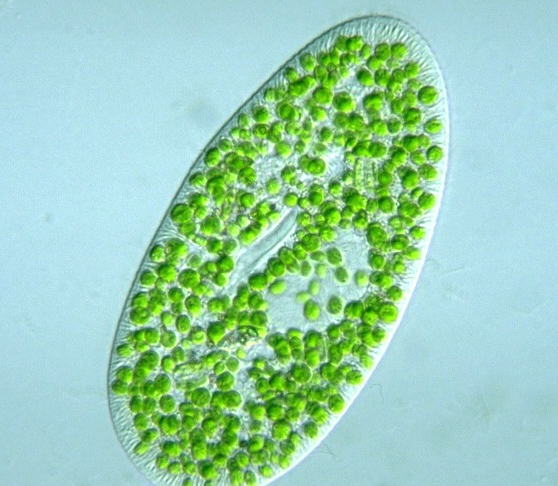
Paramecium bursaria Going Green with Chlorella


Introduction:
Paramecium bursaria, found in almost all kinds of freshwater habitats, is a species of ciliate protozoan that has a mutualistic symbiotic relationship with green alga called Chlorella. Whereas natural populations of P. bursaria are known, their Chorella-bearing counterparts are commoner in natural habitats. The algae live inside the paramecium in its cytoplasm and provide it with food, while the paramecium provides the alga with movement and protection [1]. P. bursaria is 80-150 μm long, with a wide oral groove, two contractile vacuoles, and a single micronucleus as well as a single macronucleus [1]. P. bursaria is the only species of paramecium that forms symbiotic relationships with algae, and is often used in biology classrooms as examples of protozoans, and as examples of symbiosis.

Green algae may be unicellular, multicellular, colonial, or coenocytic. They have membrane-bound chloroplasts and nuclei. Most green algae are aquatic; specifically, Chlorella is found commonly in freshwater where populations of P. bursaria are also found. Chlorella, a genus of unicellular green alga with about 100 species, is grown like yeast in bioreactors, where it has a very rapid life history [2]. It may be taken in the form of tablets or capsules, or added to foods such as pasta or cookies [2]. Taken in any form, it is said improve the nutritional quality of a daily diet [2]. According to the Taiwan Chlorella Manufacturing Company, the increase in processed and refined foods in the diet of modern man make Chlorella an important food supplement for anyone interested in better health [2].

 Figure 1. The cytoplasm of Paramecium bursaria filled with green Chlorella algae.
http://protist.i.hosei.ac.jp/pdb/images/ciliophora/paramecium/bursaria/sample_4.jpg
 
Description of the Relationship:

The symbiosis between the ciliate Paramecium bursaria and representatives of the green algae Chorella is a good example of a facultative mutualistic interaction. Among ciliate Paramecium species, only P. bursaria can maintain endosymbiotic algae in the cytoplasm [3]. In fact, algae-free P. bursaria cells hardly ever exist in natural environments. Typically, P. bursaria harbor several hundred symbiotic algae in their cytoplasm. The algae live inside the cytoplasm of P. bursaria and provide it with food, while in return, P. bursaria provides the algae with movement and protection (as depicted in the video below).

 Video 1. Mutualistic relationship between Paramecium bursaria and green algae Chlorella.
http://www.youtube.com/watch?v=zH7WEgVjZZg&feature=fvsr

A paper published by Sommaruga and Sommtag discussed the “classical” view of mutual benefits between P. bursaria and Chlorella as the efficient transfer of inorganic elements from the paramecium to the algae and of photosynthate leaking from the endosymbionts to the host [3]. Chlorella excrete large concentrations of carbohydrates used by P. bursaria to maintain its metabolism, allowing P. bursaria to become partially or totally independent of external food supply [3]. In return, the P. bursaria provides respiratory CO2  that can be photosynthetically fixed by Chlorella [3].

Cost/Benefit Analysis: 

As mentioned briefly above, the mutualistic relationship between P. bursaria and Chlorella is pretty straightforward. Serving as the host, Paramecium bursaria can supply algal cells with nitrogen components and CO2 [4]. Furthermore, when within the host, the host protects algae from infection of the Chlorella virus [4]. Also, algal carbon fixation is enhanced in the host. On the other hand, the algae can supply the host with a photosynthetic product, maltose [4]. The algae in the host show a higher rate of photosynthetic oxygen production than in the isolated stated, thereby guaranteeing an oxygen supply for the host in return [4]. It has been proven that algae-bearing P. bursaria can grow better than non-algae-bearing cells. The algae have a photo-protective role for the host [4]. Furthermore, photosynthetic products of symbiotic Chlorella are related closely to the expression of circadian rhythms in host P. bursaria [4]. Timing of cell divisions of both the algae and the host cells is well coordinated [4].

References:


[1] “Ciliates Paramecium Bursaria.” (2006) Niles Biological, Inc. Sacramento, CA. Retrieved 13 April 2012 from <http://www.nilesbio.com/prod138.html>.

[2] Guiry, Michael. (2011) “Chlorophyta: Green Algae.” University of Ireland ISRG (Irish Seaweed Research Group). Galway, Ireland. Retrieved 13 April 2012 from <http://www.seaweed.ie/algae/chlorophyta.html>.

[3] Sonntag B, Sommaruga R. (2009) Photobiological Aspects of the Mutualistic Association Between Paramecium bursaria and Chlorella. Freshwat Biol 52 : 1476 – 1485. Retrieved 13 April 2012 from <http://homepage.uibk.ac.at/~c71986/Sommaruga%20and%20Sonntag%202009.pdf>.

[4] Fujishima M, Kodama Y. (2009) Infection of Paramecium bursaria by Symbiotic Chlorella Species. Endosymbionts in Paramecium VIII, 252 p. Retrieved 13 April 2012 from <http://www.springer.com/978-3-540-92676-4>.